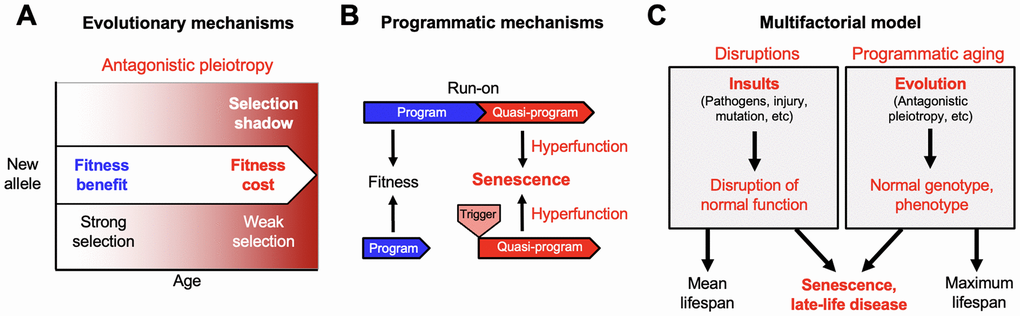
Figure 1.From the evolutionary theory to the multifactorial model. Developing new theory from foundations laid by Misha Blagosklonny. (A) The evolutionary theory of aging. Selection declines at later ages (selection shadow). Consequently, new alleles that promote fitness earlier in life but cause pathology at later ages may be favored by natural selection (antagonistic pleiotropy, AP). (B) Quasi-programmed hyperfunction. AP can be expressed as quasi-programs: genetically determined but non-adaptive derivatives of programs that promote fitness earlier in life. These may arise due to futile program run-on (top) as originally envisaged by Blagosklonny [18], or triggered reactivation (bottom) [23]. (C) The multifactorial model, in simplified form; a more detailed version was presented previously [22]. Late-life diseases are typically multifactorial in etiology. These etiologies fall into two broad categories: insults leading to disruption of normal biological function (left, e.g. infectious pathogens, mechanical injury, mutation); and programmatic action of the normal genotype (B), that are pathogenic due to the evolutionary process (A). Differences in lifespan between individuals, and mean lifespans of populations, are strongly determined by disruptions. Maximum (and also mean) lifespan is determined by programmatic aging, as specified by the normal genome. For example, the shorter maximum lifespan of the mouse Mus musculus (4 years) than the naked mole rat Heterocephalus glaber (31 years) is determined by the normal genome, not disruptions.