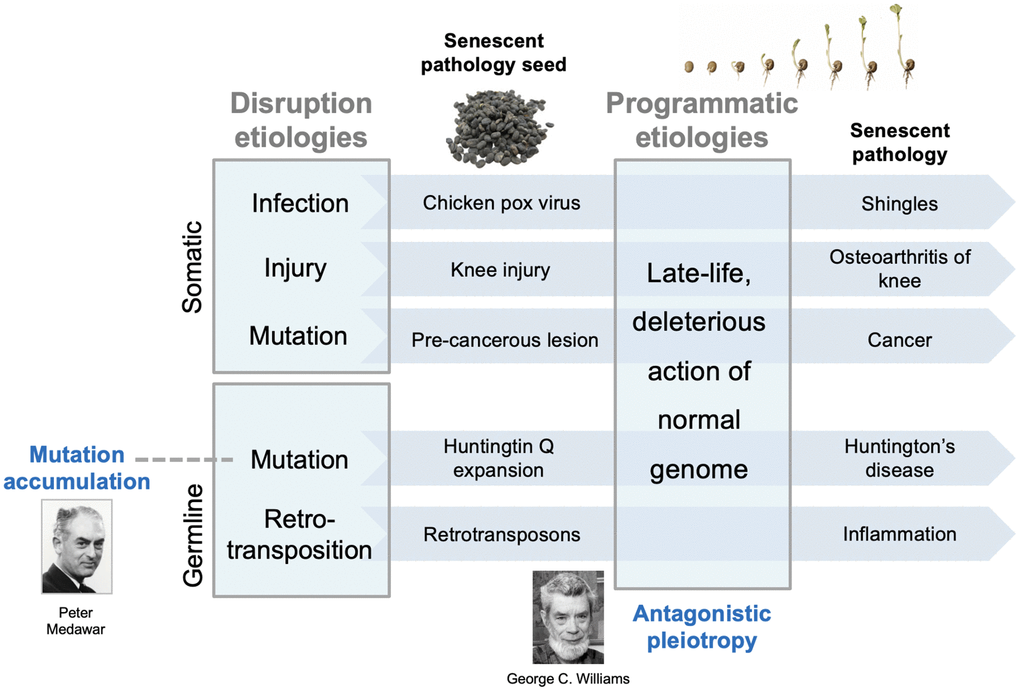
Figure 2.Two-stage model for interactions between earlier and later etiologies. Diverse disruptions of normal biological function resulting from insults are contained and lie dormant within the youthful physiological milieu. In the senescent milieu, containment of such disruptions fails, and they form foci for the development of diverse senescent pathologies. Such contained, latent disruptions are analogous to seeds lying dormant within the host; later, pathogenic wild-type gene action stimulates the seeds to grow; this analogy captures the developmental nature of senescent pathogenesis [20]. The early etiologies are those typical of disease causes prior to aging, including infection, mechanical damage, and mutation (somatic and inherited). The main, late-life etiology, wild-type gene action, is predominantly (but not entirely) restricted to senescence. The model encompasses both evolutionary theories of aging. Mutation accumulation (MA): inherited, late-acting deleterious mutations can be understood as those unmasked by later programmatic changes. Antagonistic pleiotropy (AP): this determines the late-life programmatic changes themselves. Note that this model does not argue against a role for molecular damage accumulation in aging, but rather that it is a relatively minor contributory factor (e.g. DNA damage in cancer development).