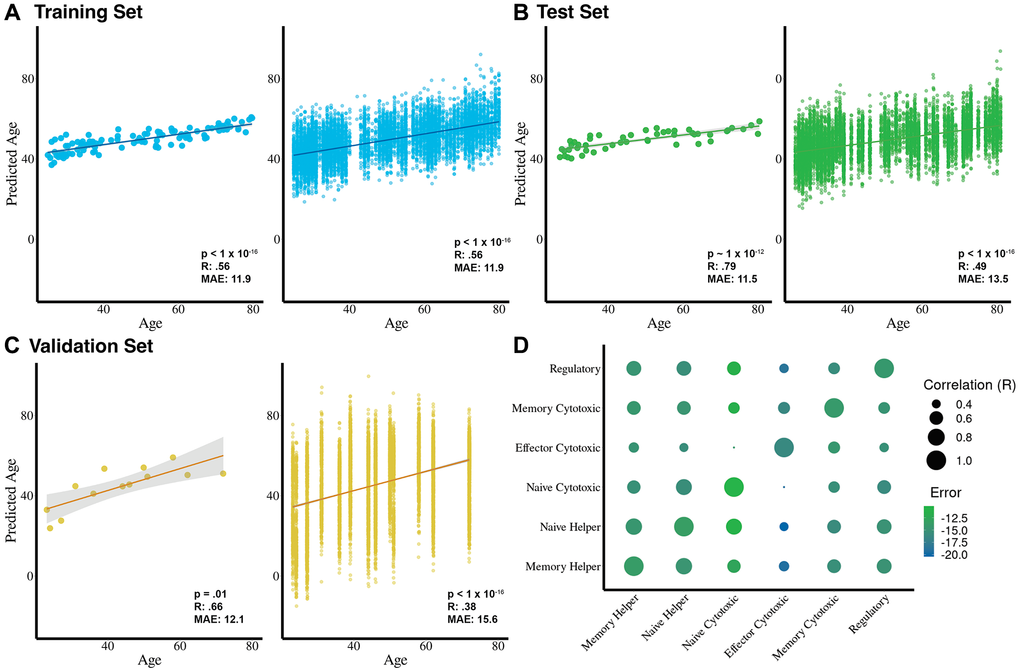
Figure 2.Cell-type-specific age prediction models predict chronological age with high accuracy and reveal unique aging signatures. (A) Training dataset results (n = 116 donors) show strong correlations between predicted and chronological age at the donor level (left; R = 0.84, MAE = 11.4 years, p < 1 × 10⁻¹⁶) and at the cell level (right; R = 0.56, MAE = 11.9 years, p < 1 × 10⁻¹⁶). (B) Test dataset results (n = 50 donors) show strong correlations at the donor level (left; R = 0.79, MAE = 11.5 years, p < 1 × 10⁻¹²) and moderate correlations at the cell level (right; R = 0.49, MAE = 13.5 years, p < 1 × 10⁻¹⁶). (C) External validation using the Yasumizu et al. (2024) dataset (n = 13 donors) reveals strong correlations at the donor level (R = 0.78, MAE = 6.5 years, p = 0.001) and moderate-to-low correlations at the cell level (R = 0.38, MAE = 15.2 years, p < 1 × 10⁻¹⁶). (D) Pairwise correlations between age predictors for each T cell subset highlight both shared and cell-type-specific aging signatures, with relative errors shown for each subset clock compared to donor chronological age on the test dataset.