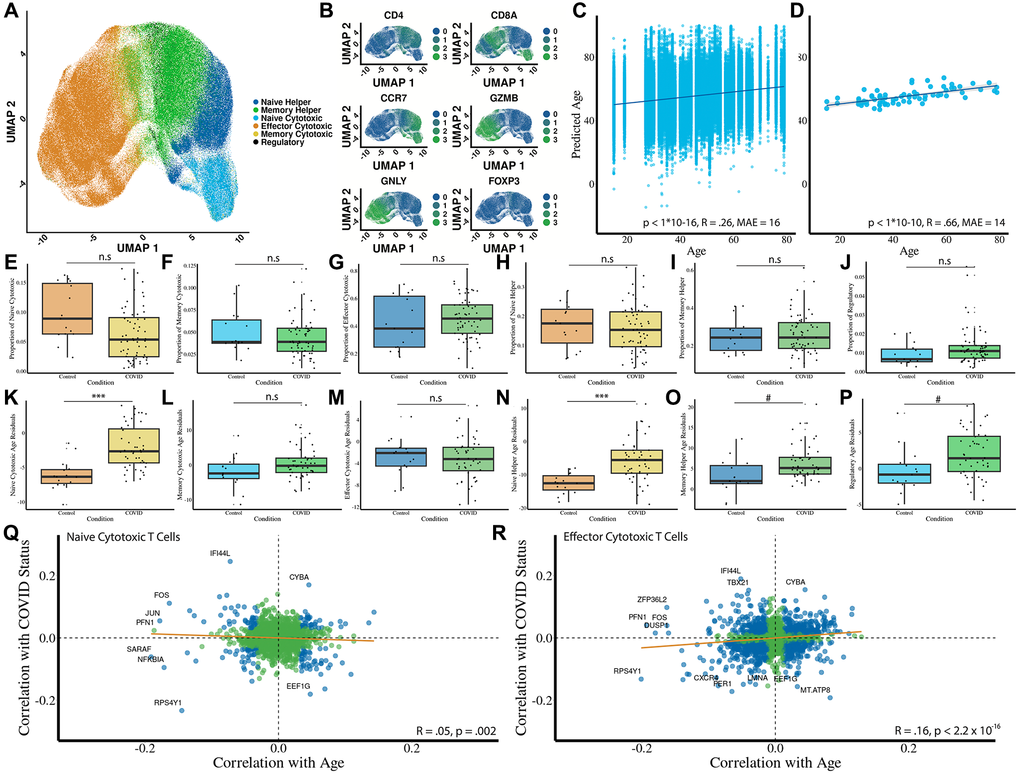
Figure 3.Acute COVID-19 impacts T cell composition, cellular aging, and gene expression through both systemic and intrinsic mechanisms. (A) Predicted cell types using the cell type prediction model (n = 15 controls; n = 48 donors with COVID-19). (B) Heatmap of canonical marker expression across predicted subsets validates the cell type predictions. Markers include CD8A, CD4, CCR7, GZMB, GNLY, and FOXP3. (C) Predicted age of individual T cells versus chronological age of donors shows a low correlation (R = 0.26, MAE = 16 years, p < 1 × 10⁻¹⁶). (D) Averaged predicted donor ages versus chronological age shows a moderate-to-strong correlation (R = 0.66, MAE = 14 years, p < 1 × 10⁻¹⁰). (E–J) Proportional changes in each T cell subset due to COVID-19. (K–P) Residual age prediction by condition for each cell type due to COVID-19. (Q, R) Gene-level analysis of shared transcriptional signatures between COVID-19 and aging in naïve and effector CD8 T cells. Correlations are shown with regression lines (orange) and statistical significance marked in blue. Statistical significance is indicated: *** Bonferroni-corrected p-value less than or equal to .001, * Bonferroni-corrected P-value less than or equal to .05, # Bonferroni-corrected P-value less than or equal to .1.