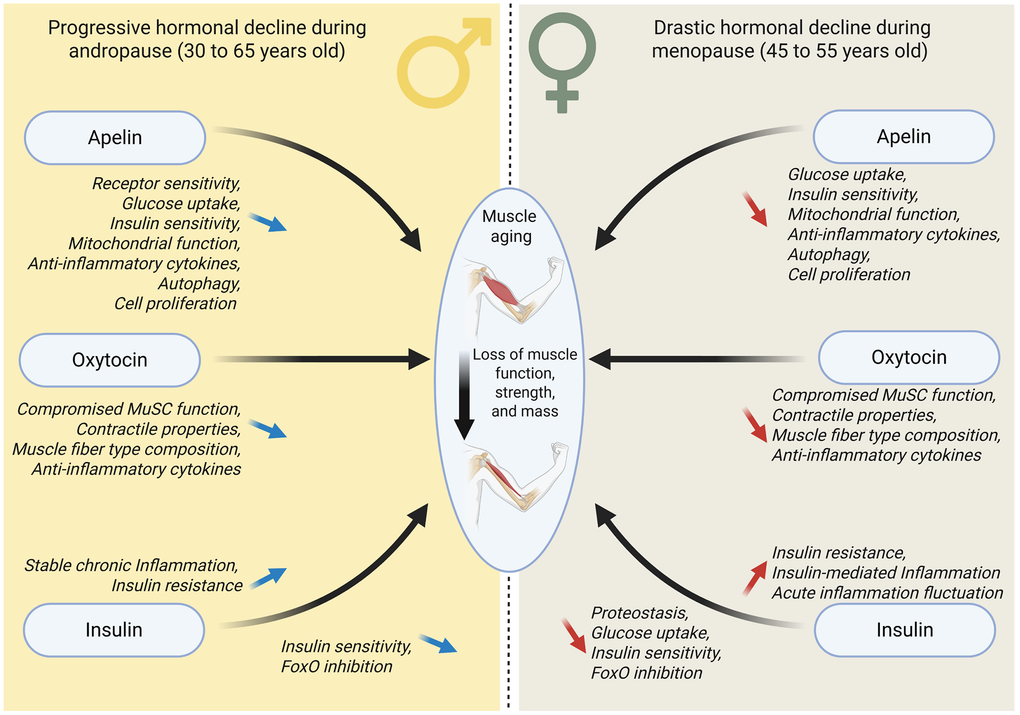
Figure 3.Sexual dimorphism in age-related hormonal changes and muscle aging. Sex-specific effects of age-related hormonal decline on muscle aging. The diagram contrasts the progressive hormonal decline during male andropause (30-65 years of age, left) with the rapid hormonal decline during female menopause (45-55 years of age, right). Black arrows indicate the declining hormone levels converging on muscle aging, and consequent loss of muscle function, strength, and mass. Blue arrows indicate progressive decline in hormone levels and their effects, while red arrows indicate rapid decline. Black italic text describes the compromised beneficial effects of each hormone in males (progressive loss), and the compromised effects in females (rapid loss). Both sexes experience reduced apelin, insulin, and signaling, leading to impaired muscle satellite cell (MuSC) function, altered muscle-fiber composition, decreased mitochondrial function, and increased inflammation, although the timeline and rate of decline differ between males and females.