Major findings
The main new findings were outlined as follows: 1) Early aged hypertension-activated neural EndoG/AIF-related caspase-independent, Fas/FasL-mediated caspase-dependent, and mitochondria-mediated caspase-dependent apoptotic pathways as well as suppressed Bcl-2 family-related and IGF-1-related pro-survival pathways in the cerebral cortex. 2) Exercise training decreased early aged hypertension-induced TUNEL positive apoptotic cells in the cerebral cortex. 3) Exercise training decreased early aged hypertension hypertension-induced neural EndoG/AIF-related caspase-independent apoptotic pathways, which was supported by the expression levels of EndoG and AIF in the cerebral cortex. 4) Exercise training reduced early aged hypertension hypertension-induced neural Fas/FasL-mediated caspase-dependent apoptotic pathway and the effect was confirmed by the reduction in expression levels of FasL, Fas, TNF-α, TNF receptor 1, FADD, active Caspase-8, and active Caspase-3 in the cerebral cortex. 5) Exercise training attenuated early aged hypertension hypertension-induced neural mitochondria-mediated caspase-dependent apoptotic pathway, as indicated by the decreases in expression levels of Bax, Bak/Bcl-xL, tBid, Apaf-1, Cytochrome c, active Caspase-9, and active Caspase-3 in the cerebral cortex; 7) Exercise training enhanced Bcl-2 family-related pro-survival protein levels (Bcl-2, Bcl-xL, pBad, 14-3-3) and IGF-1- related pro-survival protein levels (IGF-1, pPI3K/PI3K, pAKT/AKT) in the early aged hypertensive cerebral cortex. Taking our findings with the previously apoptotic theories together, we drew the hypothesized diagram (Figure 7) which suggested that cerebral cortex EndoG/AIF-related caspase-independent, Fas/FasL-mediated caspase-dependent and mitochondria-mediated caspase-dependent apoptotic pathways were augmented by early aged hypertension and were attenuated by exercise training. In contrast, the cerebral cortex Bcl-2 family-related and IGF-1-related pro-survival pathways were suppressed by early aged hypertension and were enhanced after exercise training. Exercise training not only has the neuroprotective effects through anti-apoptotic and pro-survival pathways, but also may have other indirect beneficial effects from multiple systems such as enhancing insulin sensitivity, anti-oxidative stress, anti-inflammation, hormonal balance, neuromodulatory balance, decreasing neurotoxicity, improving neuronal mitochondrial function or other unclear interaction factors [16].
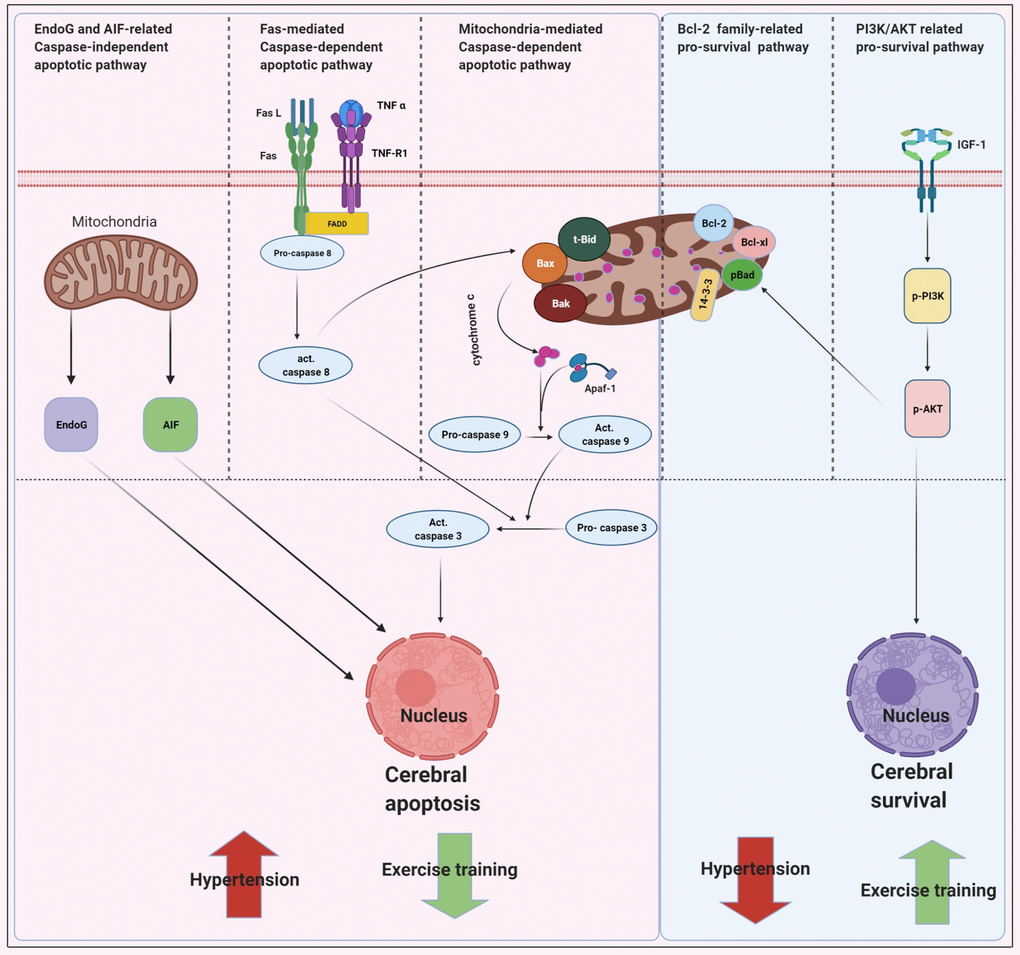
Figure 7. Proposed hypothesis indicating that early aged hypertension appear to activate the EndoG/AIF-related caspase-independent, Fas/FasL-mediated caspase-dependent apoptotic pathways (Fas ligand, Fas receptor, TNF-α, TNF receptor 1, Fas-associated death domain, active Caspase-8 and active Caspase-3) and mitochondria-mediated caspase-dependent apoptotic pathway (t-Bid, Bax, Bak, Bad, cytochrome c, Apaf-1, active Caspase 9 and active Caspase-3) as well as suppresses Bcl-2 family-related pro-survival pathway (Bcl2, Bcl-xL, p-Bad, 14-3-3) and IGF-1 related pro-survival pathway (IGF-1, pPI3K/PI3K, and pAKT/AKT). Whereas, exercise training tends to inhibits early aged hypertension-induce neural EndoG/AIF related caspase-independent, hypertension-induce Fas/FasL-mediated apoptotic and hypertension-induce mitochondria-mediated caspase-dependent apoptotic pathway as well as enhances Bcl-2 family-related pro-survival and IGF-1-related pro-survival pathway.
Hypertension is a devastating vascular risk factor for end-organ damage [34]. Increased apoptosis in hypertensive organs such as the heart (ventricular cardiomyocytes), kidney (inner cortex and medulla), and brain (cortex, striatum, hippocampus, and thalamus) was observed with extensive effect of cell death inducer [35]. Unregulated neural cell death in the cerebral cortex could be detrimental as it could deteriorate neural function and this sequester of uncontrolled cell death could be influenced in certain diseases. Hypertension induced a neural loss in the brain which would further aggravate blood flow reduction and impaired function resulting in end-stage brain damage [36]. Evidence revealed that hypertension extended ischemic brain lesions and was progressively observed to coexist with neurodegenerative illness like Alzheimer's Disease [37]. Since hypertension is the main reason for the increase of neural loss and deterioration of brain performance, therefore evaluating the degree of neural apoptosis at early stage of hypertension might be significant to minimize the subsequent complications.
Exercise training is a significant lifestyle modification for improving general body health. The benefit of exercise training in hypertension is determined by changes in the peripheral and central mechanisms of blood pressure control [11]. A previous study showed that low intensity of exercise training substantially decreased systolic blood pressure, with high chances of reducing the diastolic blood pressure in stage one-hypertension [38]. In this present study, the systolic blood pressure, diastolic blood pressure and mean blood pressure in early aged hypertensive rats were decreased after 12 weeks of exercise training on a treadmill. Base on the results of this study, we reconfirmed that exercise training could be considered as an alternative or adjunct to treat hypertension as well as an adjuvant to prevent hypertension-induced complications.
Both human and animal studies had substantiated that exercise training could effectively improve brain function and provide neuroprotection [39, 40]. Substantial reduction of AIF expression or suppressing AIF activity provided neuroprotection against intense neurodegeneration [41]. In this present study, exercise training was found to reduce hypertension-induced EndoG/AIF-related caspase-independent apoptotic pathways in the cerebral cortex which was evidenced by reduced expression levels of EndoG and AIF. No previous study had showed exercise training prevents neural EndoG and AIF in hypertensive brain, but one animal study reported that exercise training prevented neural cell death with a significant reduction of apoptosis-inducing factor (AIF) in the brain undergoing ischemia and reperfusion [25]. The suppression of EndoG and AIF protein in the early aged hypertensive cerebral cortex by exercise training was first reported in this study.
Our present study demonstrated that exercise training played a significant role in inhibiting hypertension-induced Fas/FasL-mediated caspase-dependent apoptotic pathway in the cerebral cortex, as indicated by decreased expression levels of FasL, Fas, FADD, active Caspase-8, and active Caspase-3. A previous study reported that swimming exercise on D-galactose-induced aging rats decreased protein Fas ligand, Fas, FADD and active Caspase-8 expression in the hippocampus, which ultimately suppressed apoptosis [33]. Another evidence postulated that significant down-regulation of Fas receptor was neuroprotective and could reduce posttraumatic axonal degeneration after acute spinal injury [42]. Primarily, exercise training decreased activities of Fas/FasL-mediated caspase-dependent apoptotic pathway in the cerebral cortex of early aged hypertensive rat was preliminarily revealed in this study.
Neural mitochondria-mediated caspase-dependent apoptotic pathway responding to apoptosis depends on the balance between the pro-apoptotic and anti-apoptotic factors [43]. A previous study revealed that pre-exercise suppressed pro-apoptotic B-cell lymphoma 2 (Bcl-2) family molecules such as Bid in traumatic brain injury, diminished mitochondrial permeabilization with prevented release of Cytochrome c, and decreased migration of apoptosis-inducing factor (AIF) to the nucleus and prevented caspase activation [19]. In this current study, exercise training was found to attenuate hypertension-induced neural mitochondria-mediated caspase-dependent apoptotic pathway. This corroborated finding was based on decreased expression levels of Bax/Bcl-2, Bak/Bcl-xL, tBid, Apaf-1, Cytochrome c, active Caspase-9, and active Caspase-3 in the cerebral cortex after 12 weeks of exercise training. A previous study showed that physical exercise improved brain cortex and cerebellum through reduction of pro-apoptotic Bax/Bcl-2 proportion [16].
The recovery of neurological disorders mainly relies on neural cellular survival [25]. Former research indicated that exercise training simultaneously suppressed cell death pathways and enhanced survival pathways in brain subjected with ischemia/reperfusion injury as well as increased expression of Bcl-xL proteins [25]. Increased anti-apoptotic activities reduced neuronal loss in brain ischemia [44]. Interestingly, in this investigation, exercise training was observed to enhance Bcl-2 family-related pro-survival protein levels (Bcl-2, Bcl-xL, pBad, 14-3-3) and IGF-1-related pro-survival protein levels (IGF-1, p-PI3K/PI3K, pAKT, AKT) in the early aged hypertensive cerebral cortex, suggesting another possible therapeutic approach. The increased expression of pPI3K, pAKT and Bcl-xL in the hippocampus of aging rats undergoing swimming was found essential to prevent neural apoptosis [33]. Four weeks of moderate-intensity exercise training on aging mice was found to induce 14-3-3 protein, heat shock proteins 70 and increase related neurogenesis biomarkers in the hippocampus with significant effect of enhancing neuroprotection, neurogenesis and synaptic strength [45]. Moreover, exercise training increased optimal blood flow and activated growth factors in traumatic brain injury and improved brain function via promoting neurogenesis, angiogenesis and synaptogenesis [46]. The effects of exercise training on Bcl-2 family-related pro-survival protein and IGF-1-related pro-survival protein in the early aged hypertensive cerebral cortex were first investigated in this study.